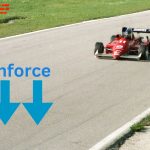
When watching a Formula 1 race, the sheer speed of the cars racing around the track can leave one mesmerized. While power and speed are essential aspects of F1, there’s a more subtle force at work that determines whether drivers can maintain control and push their vehicles to the limit—G-force. This invisible yet all-important factor, combined with downforce, allows Formula 1 drivers to navigate high-speed corners and sudden accelerations with precision. Without downforce and Gravitational force, the incredible feats that we witness on the racetrack would simply be impossible.
In this article, we’ll explore the significance of G-force in Formula 1, how it is affected by downforce, and why it plays a crucial role in the performance of both cars and drivers.
What is G-Force?
Before diving into the relationship between Gravitational force and downforce, it’s important to understand what G-force is. G-force, short for gravitational force, is the force exerted on an object as a result of acceleration. It’s measured in units relative to the force of gravity, where 1 G equals the standard gravitational pull experienced on Earth.
In Formula 1, G-force can manifest in several ways. It can occur during acceleration, braking, or cornering, placing immense pressure on both the car and the driver. The faster the car accelerates or decelerates, the greater the G-forces it experiences. Likewise, the tighter and faster a car corners, the more lateral Gravitational force is applied.
At high speeds, drivers can experience Gravitational force exceeding 5 Gs, meaning they feel five times the force of gravity. This is an enormous strain on the body and one of the reasons why Formula 1 drivers must undergo intense physical conditioning to withstand the stress over the course of a race.
The Role of Downforce in Generating G-Force
Downforce is the key component that allows Formula 1 cars to generate significant G-force without losing control. It refers to the aerodynamic force that pushes the car down onto the track as it gains speed. This increased pressure between the tires and the asphalt gives the car more grip, allowing it to handle greater Gravitational force without skidding or sliding off the track.
In essence, downforce works in tandem with G-force to ensure that the car stays stable and grounded even as it pushes the limits of physics. The more downforce a car generates, the higher the G-forces it can withstand while cornering, braking, or accelerating. Without adequate downforce, the tires would lose grip, and the car would either understeer or oversteer, making high-speed maneuvers dangerous and difficult.
Read More: Expert Says Drivers Can Cut Fuel Bills with 10 Simple Tips
How G-Force Affects Drivers
While downforce ensures that the car can handle high G-forces, the human body is not naturally equipped to endure such levels of stress. Formula 1 drivers face extreme physical challenges due to the intense G-forces they experience during races.
When a car corners at high speed, the driver can feel the G-forces pushing them sideways, making it difficult to keep their head upright. Similarly, during hard braking, the driver can feel their body being thrust forward as the car decelerates, and during rapid acceleration, they are pressed back into their seat. The constant changes in direction and speed mean that drivers are regularly subjected to forces far beyond what an average person would experience.
Over the course of a race, drivers may experience G-forces of up to 5 Gs in corners, around 4 Gs under braking, and 2 to 3 Gs under acceleration. This physical strain means that drivers must be in top physical condition, with strong neck, core, and arm muscles to handle the continuous pressure. A weak driver would fatigue quickly, leading to slower reaction times and poor performance.
Downforce and Cornering: A G-Force Game
One of the areas where downforce and G-force interplay the most is during cornering. The faster a car moves through a corner, the greater the lateral G-forces acting on it. Without downforce, a car would be unable to maintain grip and would slide outward due to inertia. However, downforce counters this by pushing the car down into the track, enabling it to corner at higher speeds and withstand greater lateral G-forces.
For example, at circuits like Silverstone or Suzuka, cars are required to take fast, sweeping corners at speeds exceeding 150 mph. In these scenarios, the G-forces generated can reach upwards of 4 or 5 Gs. The drivers must contend with the physical strain, while the cars, with their carefully designed aerodynamic packages, must generate enough downforce to stay on the track.
Teams meticulously design the aerodynamics of Formula 1 cars to maximize downforce while minimizing drag. This allows the car to generate enough downforce to handle high G-forces, especially in fast corners, while still maintaining top speed on the straights. The balance between these two factors is what makes Formula 1 cars so incredibly fast and agile.
Braking and G-Force: The Deceleration Battle
In addition to cornering, G-force plays a significant role during braking. Formula 1 cars can decelerate from 200 mph to 50 mph in just a few seconds, generating massive G-forces as the car slows down. During heavy braking, the driver may experience G-forces of up to 4 or 5 Gs as their body is thrust forward.
Once again, downforce is essential during these moments. As the car slows down, the aerodynamic drag generated by the wings and bodywork increases, helping to create more downforce. This extra force allows the tires to grip the track better, shortening the braking distance and allowing the driver to brake later without losing control.
At circuits with heavy braking zones, such as Monza or Montreal, the ability to handle high G-forces under braking is a key performance factor. Cars that generate sufficient downforce can brake harder and later, gaining valuable time in crucial parts of the race.
The Evolution of Aerodynamics and G-Force
Over the years, advancements in aerodynamics have drastically increased the amount of downforce that Formula 1 cars generate. As a result, the G-forces experienced by drivers have also risen. The development of features like diffusers, bargeboards, and vortex generators has allowed teams to manipulate airflow more effectively, maximizing downforce while keeping drag at bay.
In modern Formula 1, teams are constantly seeking new ways to improve aerodynamics and generate more downforce. The goal is to increase G-force tolerance without compromising straight-line speed or efficiency. With each passing season, innovations in this area continue to push the boundaries of what is physically possible, both for the cars and the drivers.
G-Force and Tire Management
Another important aspect of G-force is its impact on tire wear. The more Gravitational force a car generates, the greater the stress placed on the tires. This stress can lead to overheating and accelerated wear, particularly during long stints or on circuits with high-speed corners.
Teams must carefully manage tire wear by adjusting their downforce levels to suit the characteristics of each track. On circuits where high-speed cornering is crucial, teams may opt for setups that generate more downforce, which increases Gravitational forces but also wears out the tires faster. Conversely, on circuits with fewer high-speed corners, teams may choose to reduce downforce to preserve tire life and maintain straight-line speed.
Why Downforce and G-Force Matter
In the world of Formula 1, both downforce and G-force are critical to performance. Downforce ensures that the car can generate the necessary grip to handle the intense Gravitational forces experienced during a race, while Gravitational force itself challenges both the driver and the car to their physical limits. Together, these two forces define the extreme nature of Formula 1 racing.
Whether it’s through high-speed cornering, rapid acceleration, or intense braking, the interplay between downforce and Gravitational force determines how well a car can navigate the track and how far a driver can push themselves before reaching their breaking point. In the end, mastering these forces is what separates the champions from the rest.
The Hidden Force Behind the Speed
While speed and power often steal the spotlight in Formula 1, the unseen forces of downforce and Gravitational force are what truly shape the outcome of a race. They are the forces that keep the cars glued to the track and allow drivers to perform at the edge of human endurance. As technology continues to evolve, and engineers find new ways to enhance aerodynamics, the role of downforce and G-force will only grow more important in the pursuit of victory.